The sidewalk was hot enough to fry an egg, and Riley was tired of waiting for customers. His solution? The Lemon-Copter 3000—a delivery drone that was about to turn a sunny afternoon into a sticky, yellow rainstorm.
📖 Story Overview
Summary: Riley doesn’t just want a lemonade stand; he wants a lemonade empire. With his best friend Jax and a modified racing drone, they launch the world’s first “air-delivery juice service.” But when a stubborn squirrel and a gust of wind interfere, the neighborhood gets a lot more lemonade than it bargained for. A funny, relatable tale about over-engineering, teamwork, and cleaning up your own messes.
Target Audience: Kids aged 7-12, young tech-enthusiasts, and anyone who has ever had a “million-dollar” summer idea.
Educational Value: Teaches basic physics (weight and balance), the importance of beta-testing, and entrepreneurial spirit.
Riley’s garage smelled like gasoline and freshly squeezed lemons. A drop of sweat rolled down his nose as he tightened the zip-tie holding a plastic cup to the bottom of his birthday drone. “Jax, give me the payload,” he commanded, looking like a mission control specialist.
Jax poured the lemonade. It was ice-cold, with little bits of pulp floating around like tiny yellow icebergs. Glug-glug-glug. The cup was full. “Are you sure about this?” Jax asked, wiping his sticky hands on his cargo shorts. “Mr. Henderson’s porch is a long way off.”
Riley grabbed the remote. “Trust the tech, Jax. We’re going global.” He pushed the joystick. Whirrrr-vrrr-vrrr! The four propellers spun into a blur, and the drone wobbled off the folding table. It struggled for a second—carrying a cup of juice is harder than it looks—but then it soared.
The Mid-Air Catastrophe
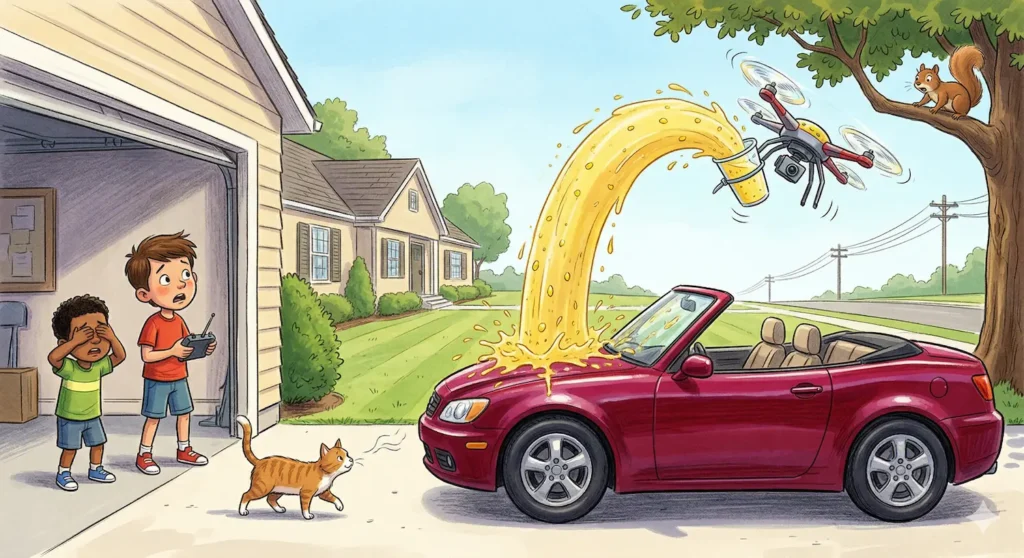
The Lemon-Copter 3000 buzzed over the sidewalk, casting a small shadow on the neighbor’s carefully mowed lawn. It reached the edge of Mr. Henderson’s driveway when a squirrel named Buster decided that the drone looked like a giant, noisy nut. Buster leapt from an oak tree branch, missing the drone but sending a wave of panic through Riley’s fingers.
Riley over-corrected. The drone tilted hard to the left. Zing-whoosh! The cup of lemonade didn’t just spill; it did a full gymnastic flip in mid-air. A giant, golden arc of sticky juice rained down perfectly onto Mr. Henderson’s brand-new, shiny red convertible. SPLAT-DIP-DRIZZLE.
“Oh, man,” Jax whispered, covering his eyes. The car was now covered in sugar and pulp. The drone, now ten ounces lighter, shot into the air like a rocket, nearly tangling itself in the power lines. Bzzzz-pop! Riley managed to land it, but the damage was done. The neighborhood cat, Barnaby, was already approaching the car to investigate the sweet-smelling rain.
Riley and Jax didn’t run. They grabbed their bucket, some soap, and a big sponge. They spent the next two hours scrubbing the red convertible until it sparkled more than it had before. Mr. Henderson watched from the window, leaning on his cane and chuckling. “Next time, boys,” he called out, “just use the doorbell. I tip better for humans than I do for robots!”
___That evening, the boys sat on the curb, sharing the last cup of lemonade—delivered by hand. It tasted better that way. The drone was back in the garage, safely tucked away until Riley’s next big “empire” idea involving a leaf blower and a skateboard.
Got a little inventor at home? 🚁
Is your child always building something new? Create a personalized story where they join Riley and Jax on a high-tech mission that (hopefully) doesn’t end in a mess!
Create Their Adventure ➜💡 Moral: Taking Responsibility
- Accountability: If you make a mess, you clean it up. It builds trust and character.
- Keep it Simple: Sometimes the high-tech way isn’t the best way. Learning when to “unplug” is a vital skill.
- Honesty: Facing the neighbor instead of hiding made a bad situation much better.
🧠 Development: Social Intelligence
Stories like Riley’s emphasize Interpersonal Repair. When children see a character make a social error (like ruining a neighbor’s car) and then take active steps to fix it, it mirrors Restorative Justice. This helps develop the Mirror Neuron System in the brain, which is essential for empathy and understanding how our actions affect the emotions and property of others.
Summer Activities FAQ
Why are lemonade stands a “classic” childhood experience?
Beyond just making a few dollars, lemonade stands teach kids basic math, social interaction, and problem-solving. It’s often a child’s first taste of independence and “business” management.
✨ Explore more Bedtime Stories: Online Books for Children
📖 Looking for another magical adventure? Check out: Pip the Caterpillar: The Hidden Colors Within →