The cafeteria smelled like a mix of floor wax and pepperoni pizza. Noah stared down at his lunchbox with a sigh. Inside sat a “Super-Green Kale Wrap” that looked more like a rolled-up yoga mat than a meal. It was time for the Ultimate Trade.
📖 Story Overview
Summary: Noah is on a mission to swap his healthy lunch for something with a little more “crunch.” Across the table sits Silas, a boy with a mysterious, grease-stained brown bag that smells like heaven. What follows is a hilarious negotiation involving a half-eaten string cheese, a vintage dinosaur sticker, and the shock of what’s actually inside the bag. A witty, relatable story about social dynamics, expectations, and cafeteria survival.
Target Audience: Kids aged 6-10, parents who struggle with “lunchbox guilt,” and anyone who remembers the stress of the school refeitório.
Educational Value: Highlights persuasion skills, value assessment, and dealing with disappointment.
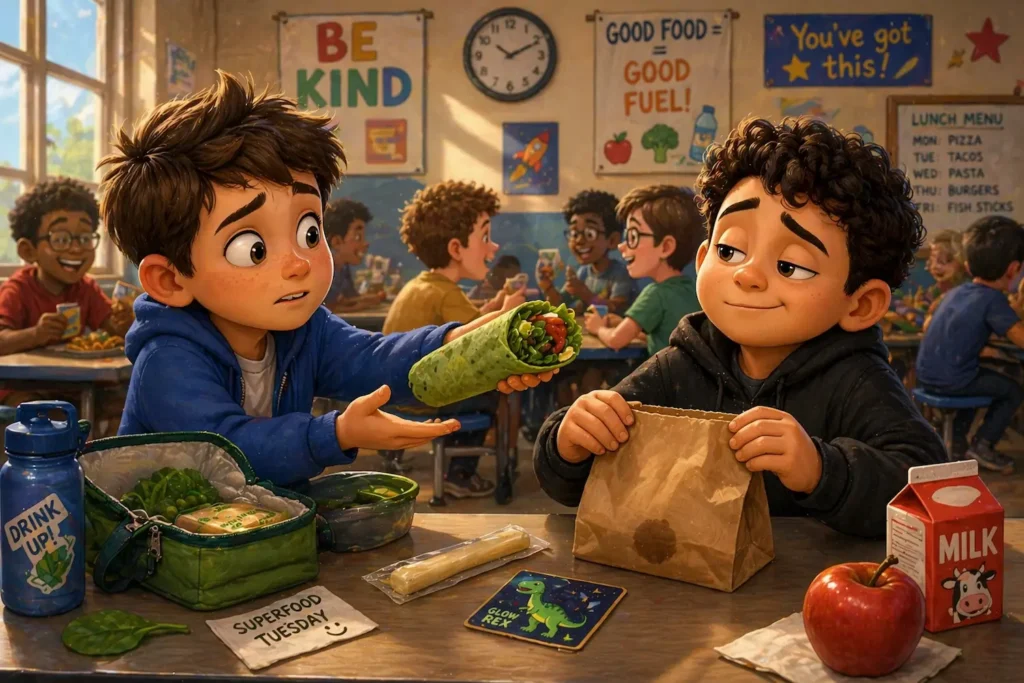
Noah unzipped his insulated lunchbag. The smell of cold spinach and disappointment wafted out. His mom was on a new “Superfood Saturday” kick, and unfortunately, it was only Tuesday. Next to him, the cafeteria was a storm of noise—clatter-bang, chatter-shout—as kids argued over who had the best Pokémon card.
Noah looked at Silas. Silas was staring at a crumpled brown paper bag like it held the secrets to the universe. The bottom of the bag had a small, translucent grease spot. That was the “Golden Signal.” Grease meant flavor. Grease meant something better than kale.
“Hey, Silas,” Noah said, trying to sound casual, though his stomach let out a loud gurgle-growl. “I’ve got a limited-edition, organic, artisan forest-green wrap here. High in… uh… vitamins.” He pushed the green lump across the sticky table.
The High-Stakes Negotiation
Silas squinted at the wrap. “Looks like a grass burrito, Noah.” He tapped his mystery bag. Crinkle-crunch. “I’ve got something special in here. My grandma made it. It’s heavy. It’s warm. And it smells like a campfire.”
Noah’s mouth watered. He could smell it now—salty, smoky, and definitely not a vegetable. “I’ll throw in my string cheese,” Noah added, peeling back the plastic with a satisfying rit-zip. “And a glow-in-the-dark T-Rex sticker. It still mostly glows.”
Silas hesitated, then nodded. “Deal.” They swapped. Noah grabbed the brown bag, feeling its wonderful warmth against his palms. He tore it open, expecting a giant slice of homemade pepperoni bread or maybe a stack of bacon sliders. Rip-tear-gasp!
He reached in and pulled out… a massive, golden-brown, deep-fried… Zucchini Blossom. It was stuffed with goat cheese and herbs. It was fancy. It was beautiful. And it was, technically, another vegetable. Noah stared at it. Silas was already happily peeling the sticker onto his notebook. “Thanks, man,” Silas munched on the kale wrap. “I love kale. My mom only lets me eat fried flowers.”
Noah took a bite of the crispy flower. Crunch-squish-mmmmm. It was actually delicious. He realized that in the world of the school cafeteria, you don’t always get what you want, but sometimes you end up with a deep-fried flower that’s way better than a boring slice of pizza anyway.
___By the time the bell rang, Noah’s brown bag was empty and his dinosaur sticker was gone. He walked back to class with the taste of goat cheese and victory on his tongue. Sometimes, the best trades are the ones that surprise you.
What’s in your lunchbox today? 🥪
Does your child have a “legendary” school story? Create a personalized adventure where they navigate the halls of their own school and win the day!
Pack Their Story Now ➜💡 Moral: Perspective is Everything
- Expectation vs. Reality: Just because something isn’t what you expected doesn’t mean it isn’t great.
- Value is Subjective: What seems like “grass” to one person might be a favorite snack to another.
- Social Courage: Talking to new people (even to trade lunch) can lead to tasty discoveries.
🧠 Development: Social Negotiation and Value
The act of “trading” in a cafeteria is a complex Neuro-Economic exercise. Children must use their Dorsolateral Prefrontal Cortex to weigh the value of an immediate item (the string cheese) against the potential reward of a hidden one (the brown bag). This builds Economic Reasoning and helps kids practice Theory of Mind—understanding what the other person wants and how to convince them to strike a deal.
School Life FAQ
Why do kids love to trade items at school?
Trading is a way for children to establish social bonds and test their independence. It’s an early form of “business” where the currency isn’t money, but stickers, snacks, and shared interests.
✨ Explore more Bedtime Stories: Online Books for Children
📖 Don't let the magic end! Next, we recommend: Ruby and Oliver: The Secret Journey of the Dream Balloons →